What is the difference between moral and ethical values?
 Andrew Ramirez
 .
Consequently, what is the difference between moral and values?
Morals are formed from the inborn values. Moral is a system of beliefs that is taught for deciding good or bad whereas values are personal beliefs or something that comes from within. These are emotionally related for deciding right or wrong. Morals do not determine the values but are formed because of the values.
Subsequently, question is, what are ethical values? In ethics, value denotes the degree of importance of some thing or action, with the aim of determining what actions are best to do or what way is best to live (normative ethics), or to describe the significance of different actions. As such, values reflect a person's sense of right and wrong or what "ought" to be.
Similarly one may ask, what is the relationship between ethics morals and values?
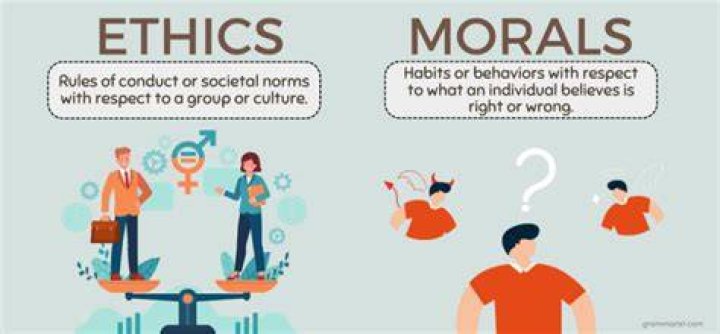
Ethics (~morality) are principles deciding what is right and wrong for an individual or a group of people. Values are principles whose implementations, one considers to be of high virtue, irrespective of them being either ethical or unethical. Ethics and Values may differ from person to person, from culture to culture.
What are your ethical beliefs?
Ethics are the set of moral principles that guide a person's behavior. These morals are shaped by social norms, cultural practices, and religious influences. Ethics reflect beliefs about what is right, what is wrong, what is just, what is unjust, what is good, and what is bad in terms of human behavior.
Related Question Answers
What are 10 moral values?
10 Moral Values for Children to Lead a Great Life- Respect. Many parents make the mistake of teaching their children only about respect for elders, but that is wrong.
- Family. Family is an integral part of kids' lives.
- Adjusting and Compromising.
- Helping Mentality.
- Respecting Religion.
- Justice.
- Honesty.
- Never Hurt Anyone.
What are examples of morals?
While morals tend to be driven by personal beliefs and values, there are certainly some common morals that most people agree on, such as:- Always tell the truth.
- Do not destroy property.
- Have courage.
- Keep your promises.
- Do not cheat.
- Treat others as you want to be treated.
- Do not judge.
- Be dependable.
What are the 3 types of ethics?
The three schools are virtue ethics, consequentialist ethics, and deontological or duty-based ethics. Each approach provides a different way to understand ethics.What are your moral values?
Moral values such as integrity, determination, loyalty, truthfulness, honesty, giving respect to each other etc should be inherited by every individual. As stated earlier moral values help us distinguish between what's right and wrong, good or bad for you as well as society.What are moral rules?
A moral rule states or expresses a relation claimed to obtain between a moral property and other, grounding properties that are correlated with its instantiation. The correlation between moral properties and their grounds is always alleged to be universal.What is ethics in your own words?
Ethics is a social science which deals with concepts such as right or wrong, moral and immoral, good and bad behaviour of dealing with one another. Ethics are the set of moral principles that guide a person's behavior. These morals are shapped by social norms, cultural practices, and religious influences.What are some examples of morals and values?
Examples of moral values include:- Being honest and trustworthy.
- Being courageous.
- Never giving up.
- Adding value to the world.
- Being patient.
- Taking personal responsibility.
What are examples of values?
Here are some examples of core values from which you may wish to choose:- Dependability.
- Reliability.
- Loyalty.
- Commitment.
- Open-mindedness.
- Consistency.
- Honesty.
- Efficiency.
What are the 7 principles of ethics?
The principles are beneficence, non-maleficence, autonomy, justice; truth-telling and promise-keeping.What are examples of ethical values?
There are many ethical values. Justice, honesty, empathy, compassion, respect and responsibility are the most important ones. Ethical values have the most important role in our life.What is an ethical dilemma example?
Ethical Dilemma Examples. In such cases, societal and personal ethical guidelines can provide no satisfactory outcome for the chooser. Ethical dilemmas assume that the chooser will abide by societal norms, such as codes of law or religious teachings, in order to make the choice ethically impossible.What are the types of ethics?
Types of ethics- Supernaturalism.
- Subjectivism.
- Consequentialism.
- Intuitionism.
- Emotivism.
- Duty-based ethics.
- Virtue ethics.
- Situation ethics.
What are my values?
Your values are the things that you believe are important in the way you live and work. They (should) determine your priorities, and, deep down, they're probably the measures you use to tell if your life is turning out the way you want it to.How can we solve ethical issues?
A Ten Step Process for Resolving Ethical Issues- Identify the problem as you see it.
- Get the story straight - gather relevant data.
- Ask yourself if the problem is a regulatory issue or a process issue related to regulatory requirements.
- Compare the issue to a specific rule in ASHA's Code of Ethics.
- Identify who has the power and control in the situation.
What does it mean to be ethical?
Being ethical means conforming to accepted moral standards. Applied to the work environment, it means that an ethical person has a higher standard than just avoiding a certain behavior or practice because it is illegal. Ethics can be applied to all aspects of business, from accounting to customer service.Why ethics and values are important?
Ethics serve as a guide to moral daily living and helps us judge whether our behavior can be justified. Ethics refers to society's sense of the right way of living our daily lives. It does this by establishing rules, principles, and values on which we can base our conduct.What are human values?
Human values are the virtues that guide us to take into account the human element when we interact with other human beings. Human values are, for example, respect, acceptance, consideration, appreciation, listening, openness, affection, empathy and love towards other human beings.What are the six core ethical values?
Trustworthiness, respect, responsibility, fairness, caring, and citizenship — are six core ethical values.What are the 3 types of values?
In thinking about values it is useful to distinguish them into three kinds:- Personal values: values endorsed by an individual.
- Moral values: values that help determine what is morally right or wrong, e.g. freedom, fairness, equality, etc, well-being.