What is a unit of acceleration?
 Andrew White
 .
Likewise, people ask, what are the standard units of acceleration?
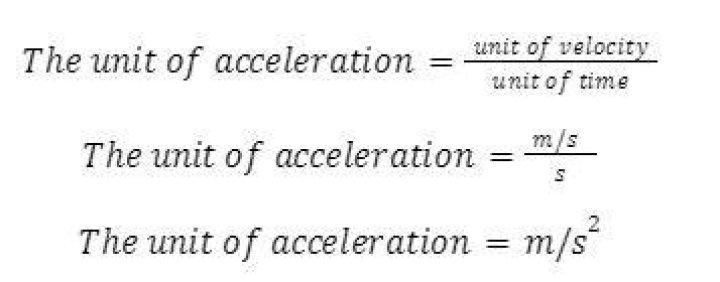
The standard unit of measurement for acceleration is meters per second squared or m/s2. You can calculate this from the above formula where velocity is meters per second and time is in seconds.
Similarly, why is the unit of acceleration M s2? Because acceleration is velocity in m/s divided by time in s, the SI units for acceleration are m/s2, meters per second squared or meters per second per second, which literally means by how many meters per second the velocity changes every second. The quicker you turn, the greater the acceleration.
Also question is, what is the unit of velocity and acceleration?
Velocity is the rate of change of position with respect to time, whereas acceleration is the rate of change of velocity. Both are vector quantities (and so also have a specified direction), but the units of velocity are meters per second while the units of acceleration are meters per second squared.
How is acceleration calculated?
Calculating acceleration involves dividing velocity by time — or in terms of SI units, dividing the meter per second [m/s] by the second [s]. Dividing distance by time twice is the same as dividing distance by the square of time. Thus the SI unit of acceleration is the meter per second squared .
Related Question Answers
What is the formula for speed?
To solve for speed or rate use the formula for speed, s = d/t which means speed equals distance divided by time. To solve for time use the formula for time, t = d/s which means time equals distance divided by speed.What causes acceleration?
Acceleration and velocityNewton's second law says that when a constant force acts on a massive body, it causes it to accelerate, i.e., to change its velocity, at a constant rate. In the simplest case, a force applied to an object at rest causes it to accelerate in the direction of the force.What are 3 examples of acceleration?
Examples- An object was moving north at 10 meters per second.
- An apple is falling down.
- Jane is walking east at 3 kilometers per hour.
- Tom was walking east at 3 kilometers per hour.
- Sally was walking east at 3 kilometers per hour.
- Acceleration due to gravity.
What is average acceleration?
Average acceleration is the change in velocity divided by an elapsed time. For instance, if the velocity of a marble increases from 0 to 60 cm/s in 3 seconds, its average acceleration would be 20 cm/s/s. This means that the marble's velocity will increase by 20 cm/s every second.What is force measured in?
A force can be a push or a pull. Forces can be measured using a device called force meter. The unit of force is called the Newton. It is represented by the symbol N. A force of 2N is smaller than 7N.How do you convert acceleration into units?
To convert from m/s2 into units in the left column divide by the value in the right column or, multiply by the reciprocal, 1/x. To convert among any units in the left column, say from A to B, you can multiply by the factor for A to convert A into m/s2 then divide by the factor for B to convert out of m/s2.What are the two units of acceleration?
Acceleration has the dimensions of velocity (L/T) divided by time, i.e. L T−2. The SI unit of acceleration is the metre per second squared (m s−2); or "metre per second per second", as the velocity in metres per second changes by the acceleration value, every second.Is velocity a speed?
Speed, being a scalar quantity, is the rate at which an object covers distance. The average speed is the distance (a scalar quantity) per time ratio. On the other hand, velocity is a vector quantity; it is direction-aware. Velocity is the rate at which the position changes.Is acceleration positive or negative?
That means that the direction of the acceleration determines whether you will be adding to or subtracting from the velocity. Mathematically, a negative acceleration means you will subtract from the current value of the velocity, and a positive acceleration means you will add to the current value of the velocity.Is there a negative acceleration?
According to our principle, when an object is slowing down, the acceleration is in the opposite direction as the velocity. Thus, this object has a negative acceleration. In Example D, the object is moving in the negative direction (i.e., has a negative velocity) and is speeding up.What is M s2 mean?
A metre per second squared (or m/s2 or metre per second per second) is a unit of measurement for acceleration. If an object accelerates at 1 m/s2, it means that its speed is increasing by 1 m/s every second.What is acceleration M s2?
Acceleration is a measure of how quickly the velocity of an object changes. So, the acceleration is the change in the velocity, divided by the time. The units for acceleration are meters per second squared (m/s2).What does 9.8 M s2 mean?
Near Earth's surface, gravitational acceleration is approximately 9.8 m/s2, which means that, ignoring the effects of air resistance, the speed of an object falling freely will increase by about 9.8 metres per second every second. The precise strength of Earth's gravity varies depending on location.Can time be squared?
It is easy to see that time is squared because acceleration is the change in position over time, over time. Take earths gravitational acceleration of . It can also be written as . So something accelerating at this speed would be going 9.8 m/s faster every second.How do u calculate distance?
The positions of the words in the triangle show where they need to go in the equations. To find the speed, distance is over time in the triangle, so speed is distance divided by time. To find distance, speed is beside time, so distance is speed multiplied by time.What are the 4 types of acceleration?
Types of Acceleration- Acceleration. Rate of change of velocity is called acceleration.
- Unit of acceleration = m/s2 or ms–2
- Types of acceleration.
- Uniform & Non Uniform Acceleration.
- Uniform Acceleration.
- Non uniform acceleration.
- Instantaneous Acceleration.
- Acceleration is determined by the slope of time-velocity graph.