What is a transformer in circuits?
 Eleanor Gray
 .
Hereof, what is transformer and how it works?
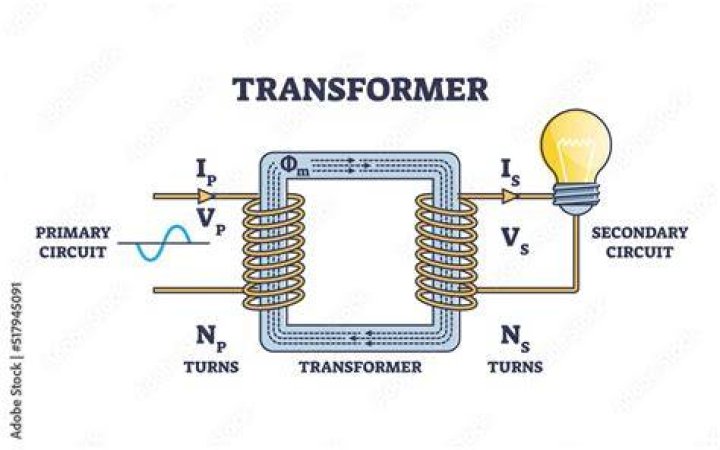
Definition:Transformer is a static device which convert electrical power from one circuit to another without changing its frequency. it Step up (or Step down) the level of AC Voltage and Current. Working principle: it works on the principle of mutual induction of two coils or Faraday Law's Of Electromagnetic induction.
Secondly, what is equivalent circuit of a transformer? Equivalent circuit diagram of a transformer is basically a diagram which can be resolved into an equivalent circuit in which the resistance and leakage reactance of the transformer are imagined to be external to the winding. R1 = Primary Winding Resistance. R2= Secondary winding Resistance.
Accordingly, what is transformer short definition?
transformer. A device used to transfer electrical energy from one circuit to another. With an alternating current, a transformer will either raise or lower the voltage as it makes the transfer.
Does a transformer convert AC to DC?
From Wikipedia, the free encyclopedia: A transformer is an electrical device that transfers energy from one circuit to another by magnetic coupling with no moving parts. Transformers alone CANNOT convert AC to DC or DC to AC; they cannot change the voltage or current of DC; they cannot change the AC supply frequency.
Related Question Answers
What are the two main types of transformer?
The primary may be connected phase to ground or phase to phase. The secondary is usually grounded on one terminal. There are three primary types of voltage transformers (VT): electromagnetic, capacitor, and optical. The electromagnetic voltage transformer is a wire-wound transformer.Why can't transformers use DC?
Ultimately, a transformer cannot work on DC because, the primary coil will create a uniform and constant magnetic field, which will fail to induce EMF in the secondary coil.What are the main parts of a transformer?
These are the basic components of a transformer.- Laminated core.
- Windings.
- Insulating materials.
- Transformer oil.
- Tap changer.
- Oil Conservator.
- Breather.
- Cooling tubes.
What is the purpose of a transformer?
Transformers (sometimes called "voltage transformers") are devices used in electrical circuits to change the voltage of electricity flowing in the circuit. Transformers can be used either to increase the voltage (called "stepping up") or decrease the voltage ("step down").What is 1 kVA in amps?
1 kVA is equal to 1,000 volt-amps and are most commonly used for measuring apparent power in generators and transformers. Amps are a measure of electrical current in a circuit. This means that amps are equal to the kVA times 1,000, divided by the voltage.How do transformers reproduce?
Both male and female Transformers reproduce asexually through the methods detailed above; although romantic relationships exist in this continuity, they are not limited to male-female pairings and there is no evidence that couples engage in anything related to procreation.What are the losses in transformer?
Transformer is a static device, hence mechanical losses (like friction loss) are absent in it. A transformer only consists of electrical losses (iron losses and copper losses). Core Loss Or Iron Loss : Core losses are due to the magnetic properties of the material used for the construction of core.What is mutual inductance?
Mutual Inductance is the interaction of one coils magnetic field on another coil as it induces a voltage in the adjacent coil. In the previous tutorial we saw that an inductor generates an induced emf within itself as a result of the changing magnetic field around its own turns.Why oil is used in transformer?
Transformer oil. It is used in oil-filled transformers, some types of high-voltage capacitors, fluorescent lamp ballasts (North America only), and some types of high-voltage switches and circuit breakers. Its functions are to insulate, suppress corona discharge and arcing, and to serve as a coolant.Who invented transformer?
Ottó Bláthy