If you take an alcohol and add thionyl chloride, it will be converted into an alkyl chloride. The byproducts here are hydrochloric acid (HCl) and sulfur dioxide (SO2)..
Thereof, is SOCl2 a good Nucleophile?
Adding Pyridine To SOCl2 Shuts Down The SNi Mechanism Even though the SNi can't occur here, we still have a very good leaving group, and a decent nucleophile – chloride ion – and so chloride attacks the carbon from the backside, leading to inversion of configuration and formation of a C-Cl bond.
what does pyridine do to alcohols? Pyridine is, in fact, more nucleophilic than the alcohol, and it attacks the acyl chloride rapidly, forming a highly electrophilic (because of the positive charge) intermediate: N-tosylpyridinium chloride. It is indeed this intermediate the actual tosylating agent which reacts with the alcohol to give the ester.
Beside above, how do I get rid of SOCl2?
SOCl2 is also rather volatile, so it can be removed with a rotovap using an acid trap (solid K2CO3 packed in a large bubbler connected between the rotovap and pump, for example). They're probably making an acyl chloride so normal work up, would fry that too.
What happens when phenol reacts with SOCl2?
Phenols do not react with thionyl chloride because Reaction with SOCl2 generally follows, SN?2 mechanism, wherein there is simultaneous formation and breaking of the bonds. But, in case of phenol the the carbon attached to the phenolic OH is sp2 hybridised and an hence the SN2 type of attack is not possible.
Related Question Answers
Why pyridine is used in thionyl chloride?
The reaction of thionyl chloride with alcohol in presence / absence of pyridine is called as Darzen's reaction. Here, the pyridine molecule acts as a catalyst which is used to neutralize the HCl -produced in the reaction.What does SOCl2 do to carboxylic acids?
As an extra bonus, thionyl chloride will also convert carboxylic acids into acid chlorides (“acyl chlorides”). Like alcohols, carboxylic acids have their limitations as reactants: the hydroxyl group interferes with many of the reactions we learn for nucleophilic acyl substitution (among others).Why is pbr3 unstable?
PI3 is unstable due to the weak bonding or overlapping of 3p-5p orbitals. The overlapping is not strong due to which it is unstable. On the other hand, the size of iodine is very large. Hence, PI.What happens when ethanol is treated with thionyl chloride?
Mechanism of the Reaction of Alcohols with Thionyl ChlorideFirst, a nucleophilic oxygen atom of the alcohol displaces a chloride ion from thionyl chloride to form a protonated alkyl chlorosulfite intermediate.What does tosyl chloride do?
Tosyl chloride (TsCl) is usually used as an activating group for primary alcohols. Due to its relatively large volume and the lower reactivity of secondary and tertiary alcohols, it usually doesn't come into them, being selective to primary alcohols in most of the cases.What happens when cyclohexanol is treated with thionyl chloride?
The first reaction uses some source of acid (usually phosphoric acid) and heat to dehydrate the alcohol and form cyclohexene. The carbonyl is electrophilic at the sulfur, so the thionyl chloride binds with the alcohol. Pyridine acts as a solvent that removes the proton.What is SN reaction?
Internal or intramolecular nucleophilic substitution reaction is known as SNi reaction. Best example of SNi is ,replacement of OH group by Cl ,by reacting alcohols with thionyl chloride. This is second order reaction as rate of reaction depends upon concentration of alcohol molecule as well as thionyl chloride.What is the molecular geometry of SOCl2?
The trigonal pyramidal is the molecular geometry of thionyl chloride, SOCl2 as it has Cs molecular symmetry. Explanation: According to the structure of SOCl2, it contains one lone pair and its hybridization is sp3. According to its hybridization and also due to lone pairs, its geometry is trigonal pyramidal.How do you quench thionyl chloride?
The key to quenching thionyl chloride then would be to use a toluene soluble reactant. Thionyl chloride reacts with many substrates, but an alcohol is a very convenient reactant and produces an organic product completely soluble in the toluene system.How does socl2 react?
Thionyl chloride reacts exothermically with water to form sulfur dioxide and hydrochloric acid: SOCl2 + H2O → 2 HCl + SO. By a similar process it also reacts with alcohols to form alkyl chlorides.How is thionyl chloride removed from a reaction mixture?
Thionyl chloride (SOCl2) can be distilled off the reaction mixture under vacuum, say, by around 40 ºC. As guideline for the required level of vacuum, I have estimated the vapour pressure of SOCl2 as 29 kPa at 40 ºC.Is pyridine a good base?
A strong base has a weak conjugate acid, as given by a small value of Ka and a large pKa. Pyridine is a weaker base than saturated amines of similar structure because its electron pair is in an sp2-hybridized orbital, and the electron pair is more tightly held by the atom.What is nucleophilic catalyst?
Nucleophilic catalysis. Nucleophilic catalysis is the enzymatic analogy to anchimeric assistance by neighboring groups in organic reaction mechanisms. Anchimeric assistance is the process by which a neighboring functional group assists in the expulsion of a leaving group by intermediate covalent bond formation.When should I take pyridine?
Pyridine is a reasonable nucleophile for carbonyl groups and is often used as a catalyst in acylation reactions. The nitrogen atom in pyridine is nucleophilic because the lone pair of electrons on nitrogen cannot be delocalised around the ring.Is POCl3 a dehydrating agent?
9.10: Dehydration Using POCl3 and Pyridine. The E2 elimination of 3º-alcohols under relatively non-acidic conditions may be accomplished by treatment with phosphorous oxychloride (POCl3) in pyridine. In every case the anionic leaving group is the conjugate base of a strong acid.Is pbr3 a strong Nucleophile?
PBr3 For Converting Alcohols To Alkyl Halides: MechanismIn the “activation” step, the alcohol is converted into a good leaving group by forming a bond to P (O-P bonds are very strong) and displacing Br from P [note that this is essentially nucleophilic substitution at phosphorus].How is alcohol converted to halide?
Treating alcohols with HCl, HBr, or HI (which all fall under the catch-all term “HX” where X is a halide) results in the formation of alkyl halides. This occurs in a two step process: first, the alcohol is protonated to give its conjugate acid. Secondly, a substitution occurs.What is N alkylation?
Amine alkylation (amino-de-halogenation) is a type of organic reaction between an alkyl halide and ammonia or an amine. N-alkylation is a general and useful route to quaternary ammonium salts from tertiary amines, because overalkylation is not possible.Why are Grignard reactions important?
The Grignard reaction (pronounced /gri?ar/) is an organometallic chemical reaction in which alkyl, allyl, vinyl, or aryl-magnesium halides (Grignard reagent) add to a carbonyl group in an aldehyde or ketone. This reaction is important for the formation of carbon–carbon bonds. 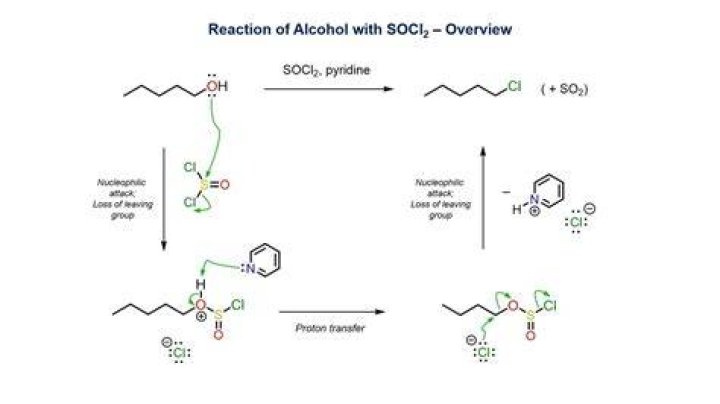
 Sophia Carter