What does a negative formal charge mean?
 William Taylor
 .
Subsequently, one may also ask, can formal charge negative?
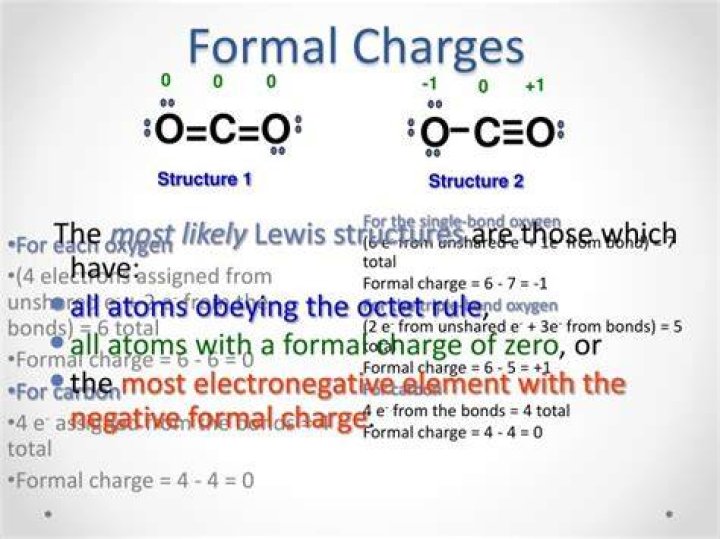
In cases where there MUST be positive or negative formal charges on various atoms, the most stable structures generally have negative formal charges on the more electronegative atoms and positive formal charges on the less electronegative atoms.
Also Know, what does formal charge indicate? In chemistry, a formal charge (FC) is the charge assigned to an atom in a molecule, assuming that electrons in all chemical bonds are shared equally between atoms, regardless of relative electronegativity.
Beside this, can carbon have a negative formal charge?
Yes, in a sense. In a Lewis structure of the compound, the carbon has a formal negative charge. You will see why below. Formal charges are an important book-keeping device that we use in Lewis structures.
What does a formal charge of zero mean?
A formal charge of zero means the atom has the best balance of bonds to lone pairs according to its valence (meaning it's stable).
Related Question Answers
Do formal charges cancel out?
It has formal charge -1. Notice that overall the carbon monoxide molecule is neutral. Oxygen has a plus charge and carbon has a minus charge. These charges cancel to give an overall neutral molecule.Why is formal charge important?
Knowing the formal charge on a particular atom in a structure is an important part of keeping track of the electrons and is important for establishing and predicting the reactivity. The formal charge on an atom in a molecule reflects the electron count associated with the atom compared to the isolated neutral atom.Why is bh4 negatively charged?
And the Boron has 8 valence electrons. So we've used all 8 valence electrons for the BH4 Lewis structure, and each of the atoms has a full outer shell. One last thing we need to do is put brackets around the ion to show that it has a negative charge. So that's the Lewis structure for BH4-, the tetrahydroborate ion.What is the formula of formal charge?
However, since the “number of bonding electrons divided by 2” term is also equal to the number of bonds surrounding the atom, here's the shortcut formula: Formal Charge = [# of valence electrons on atom] – [non-bonded electrons + number of bonds]. Let's apply it to some examples. for example BH4 (top left corner).What is the ideal formal charge?
Formal Charge. The formal charge is an idea of accounting for the distribution of electrons in an atom. This can help in two ways. Having electrons concentrated in one area will lead to regions of negative charge. The atoms that are now "missing" electrons will be positive in charge.What is the oxidation state of CO?
+2
What is the charge of K?
Table of Common Element Charges
| Number | Element | Charge |
|---|---|---|
| 17 | chlorine | 1- |
| 18 | argon | 0 |
| 19 | potassium | 1+ |
| 20 | calcium | 2+ |
What is the formal charge of h2o?
zero