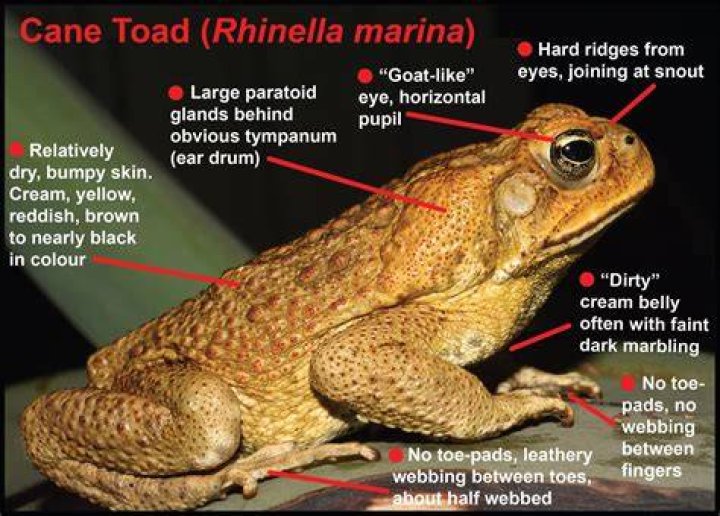
Where did the cane toad come from?
 Andrew White
 .
Just so, why is the cane toad a problem?
Cane toads are a threat to biodiversity because they are poisonous, predatory, adaptive and competitive. Cane toads are toxic at all stages of their life cycle, as eggs, tadpoles, toadlets and adults, and their ingestion can kill native predators. They pose a risk to both native animals and pets.
Also, where are cane toads found in Australia? In 2002, Cane Toads occur throughout the eastern and northern half of Queensland and have extended their range to the river catchments surrounding Kakadu National Park in the Northern Territory. In New South Wales they occur on the coast as far south as Yamba, and there is an isolated colony near Port Macquarie.
Furthermore, how were cane toads introduced?
Native to South and mainland Middle America, cane toads were introduced to Australia from Hawaii in June 1935 by the Bureau of Sugar Experiment Stations, now the Sugar Research Australia, in an attempt to control the native grey-backed cane beetle (Dermolepida albohirtum) and French's beetle (Lepidiota frenchi).
How many cane toads are in Australia?
200 million
Related Question Answers
Can a cane toad kill a human?
The skin of the adult cane toad is toxic, as well as the enlarged parotoid glands behind the eyes, and other glands across its back.How do cane toads affect humans?
Cane Toads have venom-secreting poison glands (known as parotoid glands) or swellings on each shoulder where poison is released when they are threatened. If ingested, this venom can cause rapid heartbeat, excessive salivation, convulsions and paralysis and can result in death for many native animals.Is it safe to touch a cane toad?
Toad Busting Field Safety InstructionsCane Toads are generally not poisonous or dangerous to handle. However, avoid any contact with the poison, which is exuded from the parotid gland behind their ears. The poison is only exuded by the toad when acutely stressed and it occasionally oozes from these glands.How can we get rid of cane toads?
Remove toad temptations and make your home a 'Cane Toad Free Zone'- Cover or bring in pet food at night as it attracts cane toads.
- Remove standing water.
- Remove rubbish and other debris so cane toads cannot shelter under it during the day.
- Keep your outside lights off when not needed.
- Keep toads out by creating a barrier.
How are cane toads being controlled?
Control. It is possible to control cane toad numbers humanely in a small area, such as a local creek or pond. This can be done by collecting the long jelly-like strings of cane toad eggs from the water or by humanely disposing of adult cane toads.Do Cane toads eat dog poop?
The Bufo toad is an invasive species that was introduced to Florida's sugar cane fields in 1955 to help control pests. Tilford said the Bufos are also drawn to dog poop because the poop attracts insects. Bufos will eat dog or cat food if it's left outside.How do cane toads impact the environment?
Ecological impacts of invasive cane toads. 1. The invasion of cane toads through Australia kills many large predators, that are poisoned when they try to eat large, highly toxic toads. The decrease in numbers of large predators benefits many smaller species, which increase in numbers after cane toads arrive in an area.Why didnt the cane toad solve this problem?
Cane Toad Facts, PicturesIt was introduced to Australia in 1935 to protect crops against cane beetles. The experiment failed because cane toads don't eat adult beetles and the larvae — which they would eat — live underground. The result is that the cane toad reproduced wildly and began to devastate native wildlife.How did the cane toad adapt to Australia?
Invasive cane toads adapting quickly to Australia's extremes. When predicting the spread of cane toads, Australian scientists found the invasive toads have adapted quickly to heat and water stress, allowing them to colonise areas that we wouldn't have expected based on looking at where they live naturally.Do Cane toads have predators?
In its natural habitat, i.e. South America and parts of Central America, the Cane Toad has several predators, which include the Broad-snouted Caiman and the Banded Cat-eyed Snake. Many species of Eels, Catfish, Bullet ants and Ibis also frequently prey upon the Cane Toad.What is the life cycle of a cane toad?
Life cycle of cane toadsThe eggs hatch in two or three days and the tadpole stage lasts between four and eight weeks. The toadlets can reach adult size within a year. Cane toads are omnivorous, (say om-niv-or-us) which means they eat almost anything. They forage for food at night, looking for insects and snails.How does the cane toad defend off predators?
The parotoid glands produce a poisonous secretion that helps the toad defend itself from predators. This substance, called a bufotoxin, can cause death in small animals and allergic reactions in humans. If brightly colored, they warn predators to stay away because they're poisonous.How long can a toad go without eating?
2 weeks