What is the role of water in a condensation reaction?
 Emma Horne
 .
In this regard, what happens in a condensation reaction?
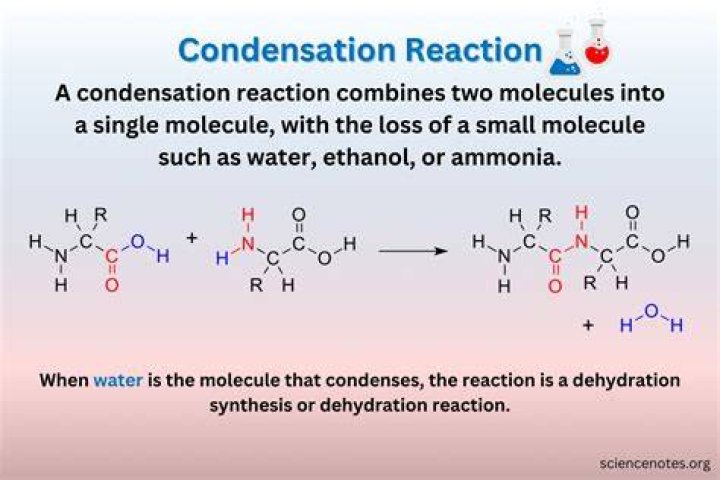
A condensation reaction is a reaction in which two molecules combine to form a single molecule. A small molecule, often water, is usually removed during a condensation reaction.
Subsequently, question is, why are condensation reactions important? Condensation (or dehydration) reactions are reactions that produce water as a product. They form new bonds which typically require energy. They are extremely important for bonding two separate molecules. One of the most important examples of this reaction is the formation of peptide bonds between two amino acids.
Also, what is needed for a condensation reaction?
Condensation reaction: A reaction in which two or more molecules combine to form a larger molecule, with the simultaneous loss of a small molecule such as water or methanol. While this occurs in many reactions, the term is usually reserved for reactions in which a new carbon-carbon bond is formed.
What is condensation of hydrolysis?
Condensation hydrolysis. e.g. A condensation reaction joins two glucose molecules to make a single maltose molecule and a water molecule. A condensation reaction is when two molecules are combined to form one single larger molecule, with the loss of a water molecule.
Related Question Answers
What is an example of a condensation reaction?
A simple example is the condensation of two amino acids to form a peptide. This reaction example is the reverse of hydrolysis, which splits a chemical entity into two parts through action from the polar water molecule, which itself splits into hydroxide and hydrogen ions.Which is the best example of a hydrolysis reaction?
Salt. Dissolving a salt of a weak acid or base in water is an example of a hydrolysis reaction. Strong acids may also be hydrolyzed. For example, dissolving sulfuric acid in water yields hydronium and bisulfate.What happens in a condensation reaction quizlet?
Condensation, also called this, refers to the removal of a water molecule during the linking of monomers. This is the opposite of a condensation reaction. During this, a water molecule is used up in the breaking of a bond between two monomers. An H is added to one monomer, and an OH is added to the other.Is condensation endothermic or exothermic?
Evaporation is endothermic, meaning it takes heat away from its surroundings. Condensation however, is the opposite with it being exothermic, where it releases heat into the surroundings.What happens in condensation polymerization?
Condensation polymers are any kind of polymers formed through a condensation reaction—where molecules join together—losing small molecules as byproducts such as water or methanol. Linear polymers are produced from bifunctional monomers, i.e. compounds with two reactive end groups.What is the opposite of a condensation reaction?
The opposite of a condensation reaction that releases a water molecule is called a hydrolysis reaction. This happens when one molecule is split into two via the addition of a water molecule.What is an example of hydrolysis?
Salt. Dissolving a salt of a weak acid or base in water is an example of a hydrolysis reaction. Strong acids may also be hydrolyzed. For example, dissolving sulfuric acid in water yields hydronium and bisulfate.What is the other name for a condensation reaction?
Dehydration. Another name for the condensation reaction. Condensation, also called this, refers to the removal of a water molecule during the linking of monomers.What are the products of the condensation reaction?
A condensation reaction occurs when two molecules join to form a larger molecule and release a smaller molecule(s) in the process. The smaller molecule lost in the reaction is often water, but it can also be methanol, hydrogen chloride, acetic acid or several other molecules.What is the difference between a condensation reaction and hydrolysis?
Condensation and hydrolysis are chemical reactions. Hydrolysis always includes water as a reactant. Condensation sometimes give water as a product. The main difference between condensation and hydrolysis is that condensation produces a smaller molecule as a byproduct whereas hydrolysis does not produce a byproduct.What do you mean by condensation reaction?
A condensation reaction is a chemical reaction between two compounds where one of the products is water, ethanol, acetic acid, hydrogen sulfide, or ammonia. A condensation reaction is also known as a dehydration reaction. The opposite of a condensation reaction is a hydrolysis reaction.What's a hydrolysis reaction?
Usually hydrolysis is a chemical process in which a molecule of water is added to a substance. Sometimes this addition causes both substance and water molecule to split into two parts. In such reactions, one fragment of the target molecule (or parent molecule) gains a hydrogen ion.Is condensation a chemical or physical reaction?
Explanation: Condensation is not a chemical change because no new compounds result, and the process can be reversed by adding energy or removing the pressure. The condensation of water vapor is the most common example because it is happening around us on a continuous basis.Is Dehydration the same as condensation?
Condensation reaction: Dehydration reaction: In chemistry and the biological sciences, a dehydration reaction is usually defined as a chemical reaction that involves the loss of a water molecule from the reacting molecule. Dehydration reactions are a subset of condensation reactions.What is condensation in water cycle?
Condensation is the process by which water vapor in the air is changed into liquid water. Condensation is crucial to the water cycle because it is responsible for the formation of clouds. Condensation is the opposite of evaporation.What is condensation with example?
Condensation is a physical change in the state of matter of a substance. Examples of Condensation: 1. Having a cold soda on a hot day, the can "sweats." Water molecules in the air as a vapor hit the colder surface of the can and turn into liquid water.Why is aldol condensation important?
Aldol condensations are important in organic synthesis, because they provide a good way to form carbon–carbon bonds. The reaction between an aldehyde/ketone and an aromatic carbonyl compound lacking an alpha-hydrogen (cross aldol condensation) is called the Claisen-Schmidt condensation.Where do condensation reactions occur in the body?
Condensation occurs in your cells constantly. It occurs in the form of a chemical reaction. These condensation reactions involve the formation of a water molecule from two other molecules. Water forms when two molecules, such as amino acids or monosaccharides, are joined together.What are the four types of condensation?
Condensation | Forms of Condensation: Dew, Fog, Frost, Mist | Types of Clouds- Evaporation. Factors Affecting Rate of Evaporation.
- Condensation. Processes of Cooling for Producing Condensation. Adiabatic Temperature Changes. Non-Adiabatic Temperature Changes.
- Forms of Condensation. Dew. White Frost. Fog. Mist. Haze. Smog. Clouds.