What is the primary goal of Emic Research?
 Eleanor Gray
 .
Regarding this, what is the primary purpose of anthropological research?
Record as much as possible of a people's language, songs, rituals, and social life because many cultures were disappearing. Where do most cultural anthropologists do fieldwork? The view that one must study all aspects of a culture in order to understand it.
Beside above, why is an Emic perspective important? An emic perspective compels the recognition and acceptance of multiple realities. Documenting multiple perspectives of reality in a given study is crucial to an understanding of why people think and act in the different ways they do.
In this regard, what is Emic approach?
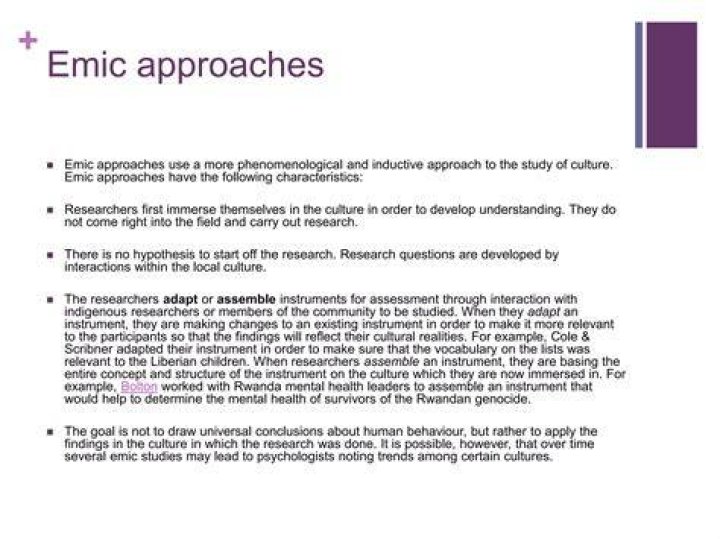
The emic approach to studying human culture focuses on the members of the culture being studied. Their words, perceptions, and beliefs are the main sources of information used to understand the culture. For this reason, the emic approach is often referred to as the 'insider approach.
Why do anthropologists use Emic approach in their research?
The goal of the emic perspective was to fully understand the culture through deep anthropological understanding and full immersion. In doing so, the framework became less cross-cultural or comparative, and focused more on ethnic-specific studies and understanding the culture from its own perspectives.
Related Question Answers
Who is the father of anthropology?
Claude Levi-Strauss: Intellectual considered the father of modern anthropology whose work inspired structuralism. Claude Lévi-Strauss was the most famous anthropologist of his generation, and one of the leading intellectuals in post-war France.What is the ultimate goal of doing anthropological fieldwork?
Through fieldwork, the social anthropologist seeks a detailed and intimate understanding of the context of social action and relations. Fieldwork in a previously unfamiliar setting has among its aims a deep understanding that encompasses as much as possible of an 'insider's' perspective.What are the three anthropological processes?
Anthropology is divided into three subfields: sociocultural, biological, and archaeology.What is anthropological research?
Anthropological research deals largely with qualitative aspects and focuses on the creation and transmission of meaning. Meaning is mediated through language and action and the best way of understanding this is through observation and engagement that is difficult through more 'traditional' research methods.What is the primary purpose of an ethnologist's fieldwork?
Compared to the historian, the archaeologist is __________. What is the primary purpose of an ethnologist's fieldwork? It provides the data needed to describe the typical behavior and thought of a group of people. Ethnology overlaps with more specific disciplines, such as literature, economics, or religious studies.What is the social goal of negative reciprocity?
' The exchange is less social, and is dominated by the material exchange and individual interests. Negative reciprocity is the attempt to get "something for nothing with impunity." It may be described as 'haggling,' 'barter,' or 'theft.Is anthropology hard in college?
Because human life is a peculiar blend of biology and culture, it is possible to study it from different angles. My area, cultural anthropology, tends to focus attention on the flexibility, breadth, and depth of cultural expression. Most of anthropology therefore is not a hard science because its subjects are not hard.Where do most anthropologists work?
Anthropologists work in practically every environment and setting imaginable. They can be found working in large corporations such as Intel and GM or studying primates in Africa. Anthropologists work in deserts, cities, schools, even in underwater archaeological sites.What is an ETIC view?
An etic view of a culture is the perspective of an outsider looking in. For example, if an American anthropologist went to Africa to study a nomadic tribe, his/her resulting case study would be from an etic standpoint if he/she did not integrate themselves into the culture they were observing.How does enculturation happen?
Enculturation is the process by which people learn the dynamics of their surrounding culture and acquire values and norms appropriate or necessary in that culture and worldviews. Enculturation is related to socialization. In some academic fields, socialization refers to the deliberate shaping of the individual.What is ETIC description?
An 'etic' account is a description of a behavior or belief by a social analyst or scientific observer (a student or scholar of anthropology or sociology, for example), in terms that can be applied across cultures; that is, an etic account attempts to be 'culturally neutral', limiting any ethnocentric, political, and/orWho created ethnography?
Bronislaw Malinowski