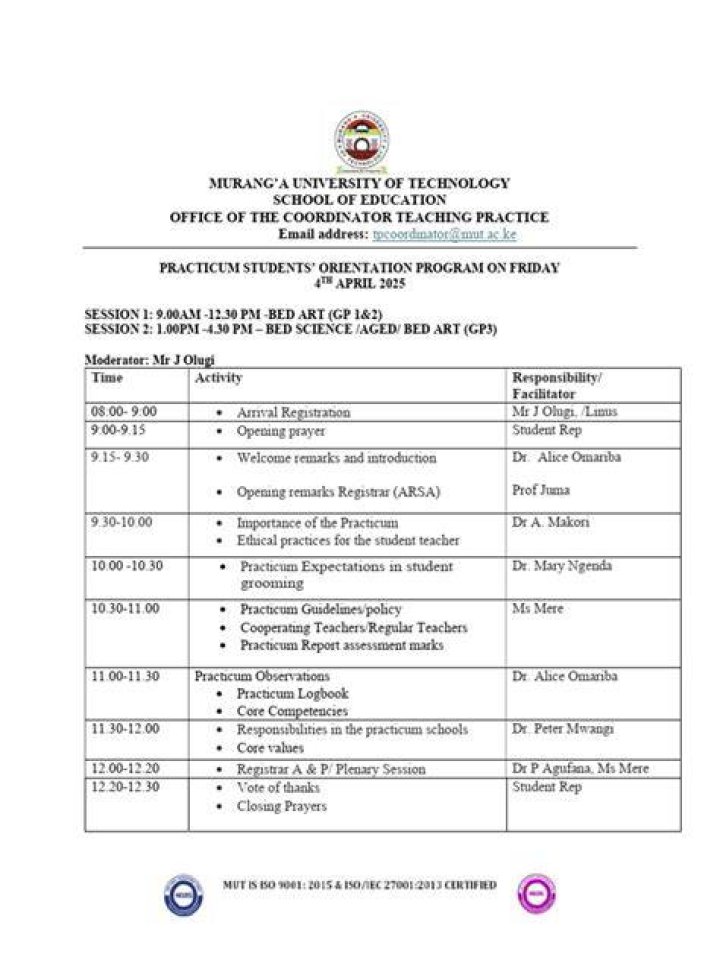
What is practicum program?
 Emily Baldwin
 .
Just so, what is practicum education?
Practicum refers to experiences that teacher trainees have in the classroom before they take on the full range of responsibilities required for student teaching. Practicum teachers partner with a professional teacher who directs their activities and gives them feedback on any work they do.
Subsequently, question is, do you get paid during practicum? Typically, practicums do not pay students because the learner is observing more than working. However, these students may be able to use financial aid while enrolled in a practicum. Some psychology internships pay learners for their work.
Simply so, what is the difference between a practicum and an internship?
basically the same thing, but practicum is usually a course with narrow learning goals (part time, like once a week for 3 hours) while internship is usually a full-time, semester-long experience where students learn the "big picture".
How do you prepare for a practicum?
For those of you who are starting your internship and/or practicum hours, here are a few tips.
- Ask a lot of questions.
- Come prepared with your schedule of available times.
- Make it your priority.
- This is your best opportunity to learn, so take it.
- Always come prepared.
- Hours, hours, hours.
Related Question Answers
How long is a practicum?
Ed the practicum takes place in years 2 and 3. For both periods the practicum extends for six weeks and takes place in semesters 2 and 1 respectively. For the two-year B. Ed candidates the practicum takes place in the final year in semester 1 and extends for six Weeks.What do you do during practicum?
Teaching practicums and internships prepare students for future teaching positions in elementary, middle school, or high school education. A teaching practicum prepares students for student teaching by giving them access to a classroom, a licensed teacher, and experience working with young learners.What is the purpose of practicum?
Practicums (also called internships or work placement programs) are designed to provide students with practical work experience. They emphasize the importance of learning by doing. They're where students can transfer their knowledge to actual work. However, not many students truly realize the importance of practicums.What is the practicum experience?
The practicum course is a planned, supervised, and evaluated practice experience. A practicum provides the opportunity to integrate and apply classroom learning in a public health work environment, enabling you to observe and learn from professionals in the field.What is another word for practicum?
Noun Synonyms. ? A college course designed to give a student supervised practical knowledge of a subject previously studied theoretically. apprenticeship. externship.Why do we need practicum?
Practicums (also called internships or work placement programs) are designed to provide students with practical work experience. They emphasize the importance of learning by doing. Practicums can also open many opportunities to network and make important contacts within the industry.What are the objectives of practicum?
The goal of the practicum is to provide an opportunity for you to synthesize, integrate, and apply practical skills, knowledge, and training learned through courses, to gain professional experience in a professional public health work environment, and to work on public health practice projects that are of particularWhat is senior practicum for nurses?
What is Senior Practicum? Practicum provides a culminating intensive clinical experience that gives the opportunity to refine your clinical practice. Emphasis is placed on integrating the multiple roles of professional nursing and serves as a vehicle for you to enhance your critical thinking and communication skills.What can I expect from a counseling practicum?
As part of the practicum, students will be expected to:- practice skills learned in previous courses;
- learn how effective they are in a helping relationship, under close supervision;
- discuss their experiences with others in a supportive setting;