Are my babies feet normal?
 John Parsons
 .
Also to know is, is it normal for my babies feet to turn out?
When feet turn inward — a tendency referred to as walking "pigeon-toed" — doctors call it in-toeing. When feet point outward, it's called out-toeing. It can be upsetting to see your child develop an abnormal gait, but for most toddlers with in-toeing or out-toeing, it's usually nothing to worry about.
Similarly, what causes deformed feet in babies? Clubfoot is a congenital condition (present at birth) that causes a baby's foot to turn inward or downward. These tight tendons cause the foot to twist out of shape. Clubfoot is one of the most common congenital birth defects. It occurs in about 1 in every 1,000 babies born in the U.S. and affects more boys than girls.
Considering this, at what age do babies feet straighten out?
Under the age of 5, children's feet grow very fast, and it's important that the bones grow straight. The bones in a baby's toes are soft at birth. If they're cramped by tight shoes or socks, they can't straighten out and grow properly. Your child won't need proper shoes until they're walking on their own.
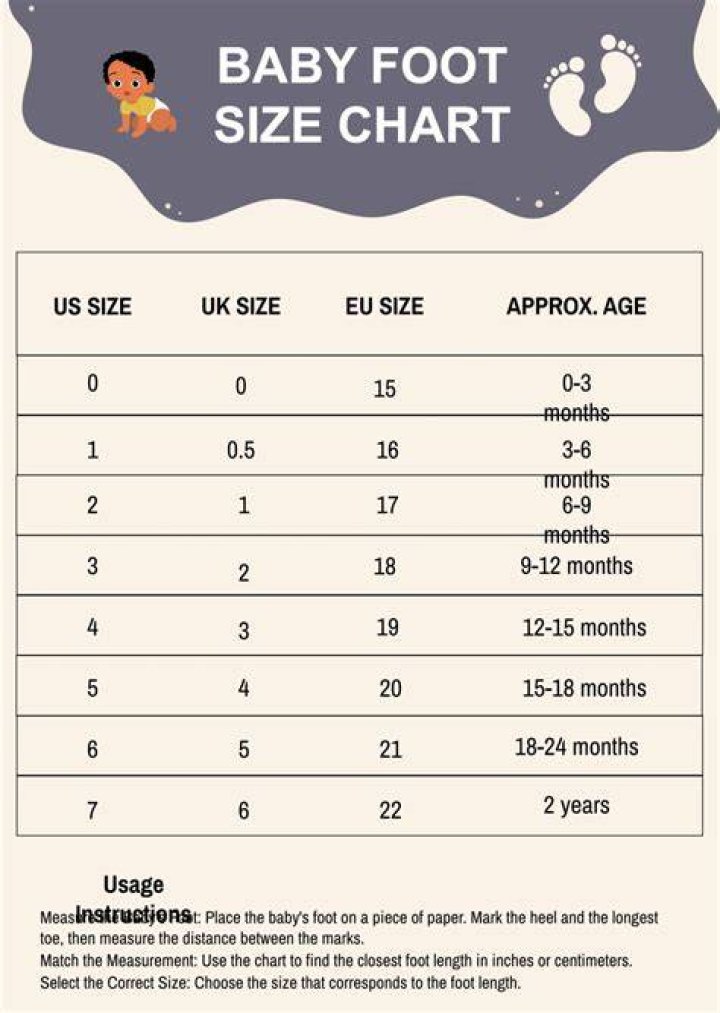
How do I know my baby's shoe size?
Measure length: Use the ruler to measure from the outside of the heel to the tip of the big toe on both feet. Write the number down in inches or centimeters, and label it as length. Remember – many kids' feet are differently sizes as they grow. Measure each foot separately to find a size that's sure to fit both!
Related Question Answers
How do I know if my baby has cerebral palsy?
Oral motor dysfunction, such as swallowing and feeding difficulties, speech impairment, and poor facial muscle tone can also indicate Cerebral Palsy. Practitioners will also look for signs such as abnormal muscle tone, unusual posture, persistent infant reflexes, and early development of hand preference.Are babies that walk early smarter?
Children who start walking early turn out later to be neither more intelligent nor more well-coordinated. On average, children take the first steps on their own at the age of 12 months.Why do babies move their arms and legs so much?
Your baby is slowly gaining control over his muscles. Your baby may move his arms and legs to show his interest in the action around him. Your baby may have sudden jerking movements, so when you are carrying him, be careful to support him well.Is it normal for babies to curl their toes?
Curly toes is a common condition that affects infants and children and it is present from birth. The toes curl under because the tendons that bend the toes are too tight and pull one toe under the next toe, curling it towards the underside of the foot, as is seen in the picture above.How can I strengthen my baby's legs?
Instead, give your baby a leg up with activities that'll strengthen his legs and give him the freedom he needs to develop standing skills.- Exercise. Physical activities make for quality one-on-one time.
- Bounce.
- Let him loose.
- Peek-a-boo.
- Encourage with toys.
- Play with others.
- Cheer him on.
Can a baby with hip dysplasia walk?
Hip dysplasia in babies is most frequently discovered at the time of newborn examinations by physicians but dysplasia and dislocation can develop after this time in some children. It does not cause pain in babies and doesn't normally prevent them from learning how to walk at a normal age.Is out toeing genetic?
Genetics is believed to play a role, but so may the position of the fetus in the womb. Other, much less common abnormalities in a child's bone or muscle structure can account for out-toeing, some being more serious than others.When should babies crawl?
When to Expect Crawling to BeginBabies typically begin to crawl between 6 and 10 months, although some may skip the crawling phase altogether and go straight to pulling up, cruising, and walking. Help your babe get ready for his crawling debut by giving him lots of supervised tummy time.Why do babies straighten their legs?
Your baby's legs to be bowed or feet turned up — This is caused by being held tightly in the womb. Your baby's legs will straighten out within six to 12 months.What causes baby Talipes?
Clubfoot is mainly idiopathic, which means that the cause is unknown. Genetic factors are believed to play a major role, and some specific gene changes have been associated with it, but this is not yet well understood. It appears to be passed down through families. It is not caused by the fetus' position in the uterus.Why does my baby have fat feet?
You may have noticed your baby's feet are flat. This is because she has a layer of puppy fat surrounding and protecting her pliable bones. If she tries to stand too early and lots of pressure is placed on her feet, it can cause them to misalign or grow out of shape.Can Intoeing be corrected?
In the vast majority of children younger than 8 years old, intoeing will almost always correct itself without the use of casts, braces, surgery, or any special treatment. Intoeing by itself does not cause pain, nor does it lead to arthritis.What is Talipes?
Club foot (also called talipes) is a birth defect that can affect one or both feet. Early treatment usually helps correct it. Club foot is quite common, affecting about 1 baby in every 1,000 born in the UK. Both feet are affected in about half of these babies.Why do babies hands and feet turn blue?
Acrocyanosis is a painless condition where the small blood vessels in your skin constrict, turning the color of your hands and feet bluish. The blue color comes from the decrease in blood flow and oxygen moving through the narrowed vessels to your extremities. Acrocyanosis is common in newborns.What do I do if my child is pigeon toed?
When the thigh bone twists, the knees and toes point in. Children with a twisted thigh bone often sit with their legs crossed. The best way to treat this is to have the child sit in a chair with their legs uncrossed. Often this cannot be done until they are school age.Why does my child walk on her toes?
Causes. Toe walking can be classified into four groups. Some neurological conditions such as cerebral palsy or muscular dystrophy cause the calf muscle to be tighter or change the way it works. However, some children who can get their heels to the ground prefer to walk up on their tip toes.What counts as baby's first steps?
As your baby's muscles develop, the stages leading up to walking typically include:- Learning to sit independently (around 6 months old).
- Crawling (around 6 to 9 months old).
- Pulling up to stand (around 9 months old).
- Holding onto furniture to take a few steps (around 9 to 12 months).
Is Clubfoot a sign of Down syndrome?
It appears that, even though Down's syndrome is usually characterized by ligamentous laxity, when clubfeet are associated with this syndrome they are often resistant to nonoperative treatment, and surgical treatment seems to produce an acceptable result.How can I straighten my baby's toes?
Your doctor or physical therapist may be able to suggest more exercises.- Gently pull on your toes to stretch the bent joints. For example, if a joint bends up, gently stretch it down.
- Do towel curls. Put a towel flat under your feet and use your toes to crumple it.
- Do marble pickups.